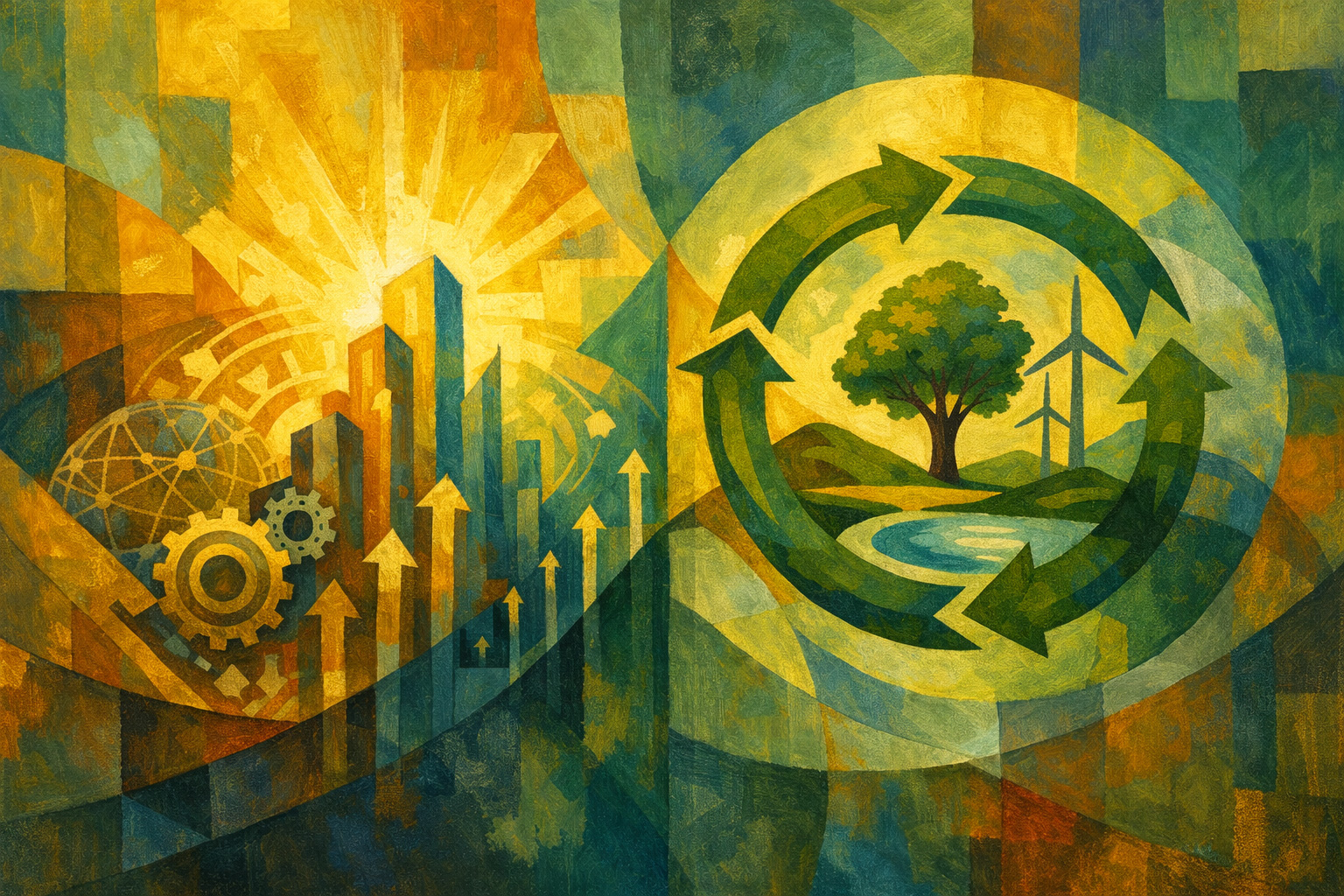
In recent years, the idea of a regenerative economy has gained remarkable traction in academic, institutional, and corporate discourse. It is often presented as the natural evolution of sustainability: an economy that does not merely reduce harm, but actively restores ecosystems, communities, and social capital. In a world facing environmental degradation and social fragmentation, regeneration appears not only desirable but morally necessary.
And yet, precisely because of its apparent moral clarity, the regenerative paradigm deserves closer scrutiny.
The regenerative economy is, at its core, a response to damage. It emerges from the recognition that industrial and extractive models have depleted natural and social systems beyond safe thresholds. Its ambition is to heal, to repair, and to rebalance. While this represents a significant step forward compared to purely extractive or efficiency-driven models, it remains conceptually anchored to the past. Regeneration presupposes a prior state of balance to which the system should, in some way, return.
This assumption becomes problematic when we consider the nature of contemporary economic systems. Economies are not closed biological loops that can simply be restored to an original equilibrium. They are complex, adaptive, and historically irreversible systems. Technological acceleration, global interdependence, and now the widespread diffusion of artificial intelligence have radically altered the conditions under which value is created. In such a context, the idea of “returning” to a previous state—even an idealized one—risks becoming an intellectual shortcut rather than a viable strategy.
In practice, this limitation often manifests in the way regenerative principles are adopted by organizations. Regeneration is frequently translated into incremental improvements: more responsible sourcing, circular processes, reduced emissions, ecosystem restoration initiatives layered onto existing business models. While valuable, these efforts often function as retrofits rather than transformations. The underlying logic of the organization remains unchanged; regeneration becomes an additional constraint, not a generative force.
There is a deeper risk here. When regeneration is framed primarily as a corrective mechanism, it can be absorbed by the very system it seeks to reform. It becomes compatible with the status quo, offering moral legitimacy without fundamentally questioning how value is conceived, produced, and distributed. In this sense, regenerative practices may slow down deterioration, but they rarely redefine the trajectory of the system itself.
It is at this point that the notion of a generative economy, or generativity, becomes relevant—not as a replacement for regeneration, but as a conceptual shift that goes beyond it.
A generative economy does not start from damage, but from potential. Rather than asking how to repair what has been broken, it asks what new forms of value can emerge in conditions of uncertainty and complexity. Its focus is not on restoring balance, but on enabling continuous creation: of meaning, relationships, capabilities, and futures that did not previously exist.
This distinction is particularly important in the age of generative technologies. Artificial intelligence systems do not merely optimize existing processes; they recombine knowledge, generate novel outputs, and reshape how decisions are made. Applying a purely regenerative lens to such technologies risks underestimating their transformative nature. A generative economy, by contrast, recognizes technology as a catalyst for new economic grammars, not just as a tool for efficiency or repair.
From a managerial perspective, this shift has profound implications. Regenerative thinking tends to frame responsibility in terms of impact reduction and system restoration. Generative thinking reframes responsibility as future-making. The central question changes from “How do we minimize our negative footprint?” to “What kind of world becomes more likely because this organization exists?”
In marketing and management, this implies moving beyond narratives of responsibility and compliance toward the deliberate design of meaning. Value is no longer communicated solely through claims of sustainability or regeneration, but through the ability to articulate and enact new possibilities for stakeholders. In a generative economy, organizations are not evaluated only by how well they repair damage, but by how effectively they expand the space of what is possible.
This does not mean that regeneration is irrelevant. On the contrary, regenerative practices remain necessary wherever systems are degraded or fragile. However, they are insufficient as a guiding paradigm for the future. Regeneration addresses yesterday’s problems; generation addresses tomorrow’s conditions.
The risk of stopping at regeneration is subtle but significant. It may lead organizations to optimize their relationship with the past while remaining unprepared for futures that cannot be extrapolated from existing models. In a world characterized by discontinuity rather than linear progress, economic thinking must shift from restoration to creation.
Ultimately, the generative economy does not reject regeneration; it subsumes it. Repair becomes a baseline, not a horizon. The real strategic and ethical challenge is no longer to rebuild what once worked, but to generate forms of value capable of sustaining prosperity in contexts that have no historical precedent.
That is where the future of economic thinking is likely to unfold—not in the act of returning, but in the capacity to generate.