For decades, we have organized work around a distinction that appeared neutral, almost technical: the separation between hard skills and soft skills. It has become so pervasive that we rarely question it. It structures résumés, educational programs, corporate hierarchies. It silently defines what we consider valuable.
Hard skills are measurable, certifiable, technical. They are concrete. They produce visible output. Soft skills, by contrast, are relational, interpretative, dialogical. They accompany rather than generate. Even the terminology reveals an implicit hierarchy: what is “hard” supports and builds; what is “soft” smooths and mediates.
This distinction did not emerge by accident. It is the cultural outcome of an era that privileged formalization, quantification, and technical production as the primary sources of value.
The intellectual background of the twentieth century — from logical positivism to the rise of computational thinking — reinforced the belief that what can be formalized is what truly counts. After World War II, reconstruction demanded engineers, technicians, and specialists. Expertise meant production. Efficiency meant progress. The technical professional became the model of competence. Knowledge was procedure; value was output.
When digital technology emerged and software reshaped the economy, this hierarchy only intensified. Coding became the new literacy of power. Those who could program were seen as shaping the future. For at least three decades, markets rewarded this assumption.
Yet something has shifted.
In recent months, financial markets have delivered a signal that deserves careful interpretation. In early 2026, global software stocks experienced one of the sharpest corrections in years, wiping out nearly $1.6 trillion in market capitalization. Companies such as ServiceNow and Salesforce saw dramatic drops in valuation as investors began reassessing the long-term impact of generative AI on traditional software business models.
Perhaps the most symbolic case was IBM. On February 23, 2026, its stock suffered its worst single-day drop in more than twenty-five years, falling over 13 percent after announcements that new AI systems were capable of automating complex legacy code modernization tasks once considered core to specialized human expertise. Billions in market value evaporated in hours.
These events are not merely financial fluctuations. They reveal something deeper: a collective realization that many of the competencies we once treated as “hard” — and therefore foundational — are, in fact, automatable.
Writing code, translating documents, summarizing data, structuring information — activities that required years of training and high salaries — can now be performed by generative models with astonishing speed and increasing reliability. What is collapsing is not technology itself, but the hierarchy of value that placed technical execution at the top.
And here we encounter the philosophical core of the issue.
The distinction between hard and soft skills begins to look like a semantic mistake. What we called hard was not ontologically solid; it was simply technically executable. What we called soft was not weak; it was simply difficult to measure.
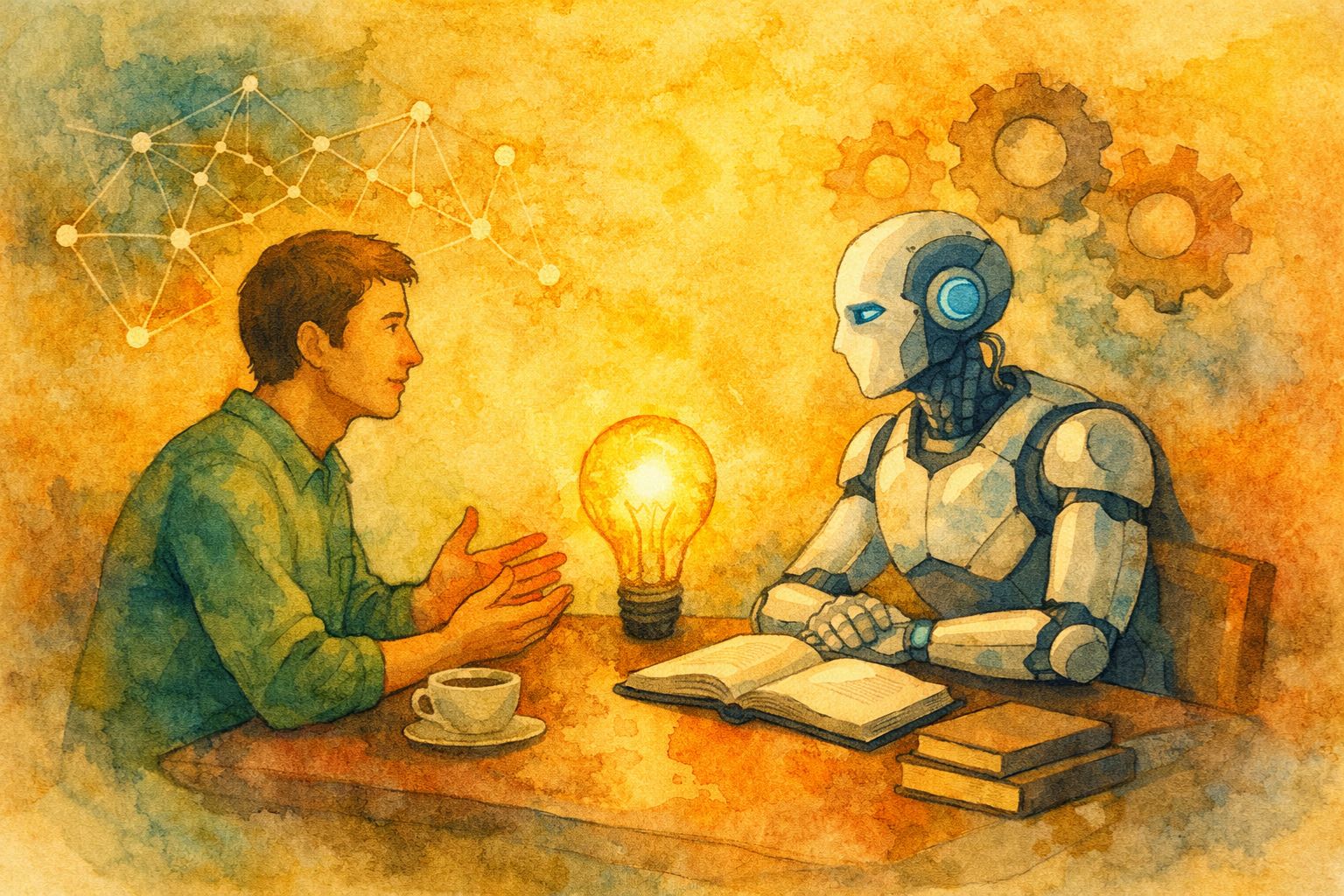
Artificial resources — algorithms, models, automated systems — are organized power. They calculate, correlate, generate. They amplify. But they do not intend. They do not decide what is worth solving. They do not assign meaning to the problems they process.
An AI system can generate code. It cannot determine whether the project it supports contributes to human flourishing. It can optimize logistics. It cannot judge whether the underlying strategy is ethically sound. It can connect data points. It cannot decide which connections matter for society.
This is where the truly human dimension re-emerges.
What remains irreducible is not manual execution or technical formatting. It is judgment. It is synthesis. It is the capacity to ask questions before answering them. It is what Aristotle called phronesis — practical wisdom — and what we might now call critical integrative thinking.
In an age where execution is increasingly delegated to machines, value migrates toward orientation. The scarce resource is no longer technical capacity; it is the ability to define direction. The most important competence is not the ability to produce output, but the ability to decide what output should exist in the first place.
The recent turbulence in tech markets can be read as a crisis of meaning disguised as a valuation correction. Investors are not merely questioning revenue models. They are sensing that the center of gravity has shifted. If artificial systems can perform the technical core of many businesses, then technical mastery alone cannot justify enduring value.
The future does not belong to those who can execute faster than machines. It belongs to those who can integrate machines into a broader vision.
This is not a nostalgic return to the humanities. It is a structural necessity. Organizations that adopt generative systems do not eliminate human resources; they redefine them. The human role moves from execution to orientation, from repetition to responsibility.
The irony is striking. For decades, we labeled as “soft” the very capacities that now prove structurally decisive: critical reasoning, ethical reflection, systemic thinking, the ability to connect distant domains into coherent strategies. These are not ornamental skills. They are meta-technical competences. They govern how technical power is deployed.
Artificial resources increase potency. Human resources determine direction.
The real divide of our time is not between humans and machines. It is between those who delegate blindly and those who integrate consciously. Between those who confuse automation with intelligence and those who understand that intelligence without responsibility is incomplete.
We are not witnessing the replacement of human resources by artificial ones. We are witnessing a redistribution of functions. Intelligent automation absorbs repetitive, procedural, and computational tasks. Humans are compelled — perhaps for the first time in decades — to reclaim their role as meaning-makers.
In this sense, the so-called collapse of hard skills is not a decline. It is an unveiling. It reveals that the most solid competence was never technical execution. It was the capacity to orient power toward human purposes.
Artificial systems can scale our capabilities. They cannot define our ends.
And in that space — the space of ends, of responsibility, of integration — human resources become indispensable in a way that no automation can erase.